CANTEMIR MELO – Complete Cantemir compositions – Anton Pann Early Music Chamber Ensemble
Prince Dimitrie Cantemir (1673-1723) represents a unique figure for Eastern European culture: a personality of Romanian and universal culture, Dimitrie Cantemir remained in history as a polymath intellectual who marked his passage through life with works written in various fields.
As the son of the Voivode of Moldavia, he spent a large part of his youth in Istanbul, where, in addition to learning the languages of the time, he studied music with the best performers and composers. During this period he became the leading theorist of the Turkish language and one of the great composers of the time. His treatise "The Book of the Science of Music" (c. 1700) includes a system of musical notation involving the Ottoman alphabet, with the help of which he was able to transcribe 353 pieces from the instrumental repertoire of the Court, as well as his own compositions. Based on recent research (W. Feldman and O. Wright) 18 compositions have been identified as belonging with certainty to Dimitrie Cantemir - these being those included on the two CDs performed by the Anton Pann Early Music Chamber Ensemble.
Thus, considering the Romanian cultural specificity of Byzantine origin and the fact that Dimitrie Cantemir himself studied at the school of the Ecumenical Patriarchate of Constantinople, where religious music of the Byzantine tradition is also taught, in the analysis and interpretation of Cantemir's compositions, the compositional principles specific to this geographical space were used, combining the Byzantine, Romanian and Ottoman languages, with the idea of helping the music-loving public to mentally visualize the soundscape of Eastern Europe in the 18th century.
Although this is an academic, research-based approach, a sound accessible to the public was built, resulting from carefully chosen instrumental timbre combinations. Thus, it was decided to use oriental instruments such as oud, kanun, daire, bansuri, duduk, and instruments specific to Western orchestras: violin, cello, flute, the resulting melody being considered representative of the multiculturalism of the Romanian Principalities and of present-day Romania.
In this project, photocopies of the Cantemirian manuscript were used, as well as the transposition variants from the notation created by the prince into Western (guidonic) notation. The easiest source (melodic) was that of Owen Wright, who made his transcription using Eugenia Popescu-Judetz's variant among his sources.
The complete Cantemir compositions appeared on a double CD, whose elaborate details recall the predominant aesthetics of the Romanian Principalities in the 18th century: graphics inspired by oriental architectural lines, gold leaf stamping on the cover, stitching on the spine to recall the books of the Middle Ages. The CD also contains a booklet that highlights Dimitrie Cantemir's musical evolution, as well as the historical context of his time.
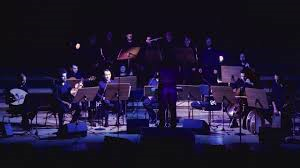
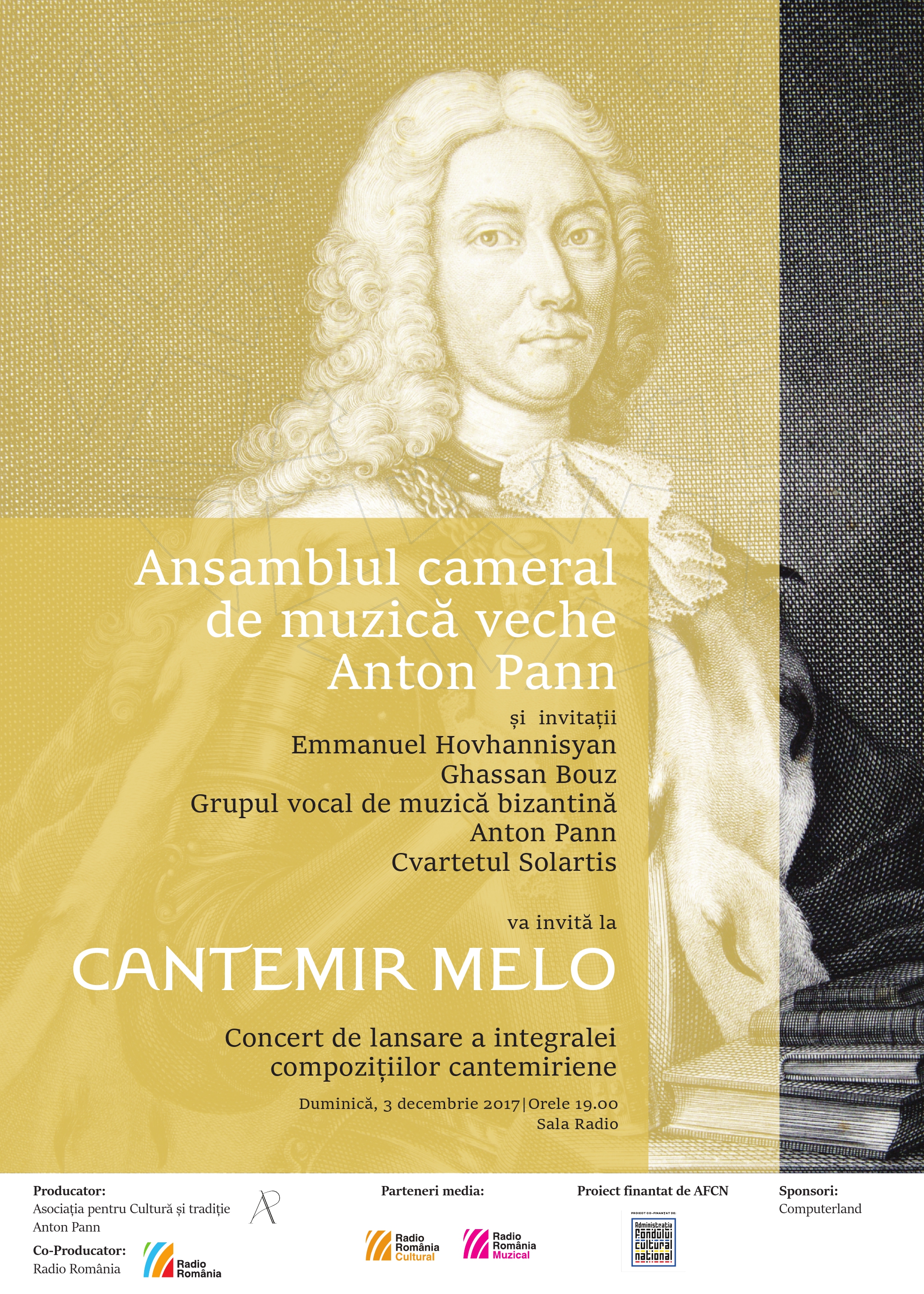
At the Cantemir Melo launch concert at the Radio Hall on December 3, 2017, the Anton Pann Early Music Ensemble (Constantin Raileanu – voice, percussion – daire, kanun, conductor and orchestrator, Sabin Penea – violin, Alexandru Stoica – oud, Issam Garfi – bansouri flute and ney, Andrei Nitescu – cello and Oana Benko – video projection), were joined by special guests: Emmanuel Hovhannisyan (Armenia, duduk) and Ghassan Bouz (Lebanon, percussion), and in the second part of the concert by the Anton Pann Byzantine Music Group, Adrian Flautistu (double bass) and the Solartis Quartet.
This album is also promoted in the countries where Dimitrie Cantemir has been appreciated over time (Turkey, Russia, Greece, France, Germany, England, Holland, Sweden, Italy), aiming to promote Romanian personalities in general, and the musical work of Prince Cantemir in particular.
Computerland Romania supported the Anton Pann Early Music Chamber Ensemble in its chosen mission: rediscovering the beauty of early Romanian music and sharing it, with joy, with the music-loving public and beyond.
This album is a tribute to Dimitrie Cantemir and to Romanian culture, enriched by the creative work he did throughout his life, so that it can be considered an ideological precursor to the Great Union of 1918.