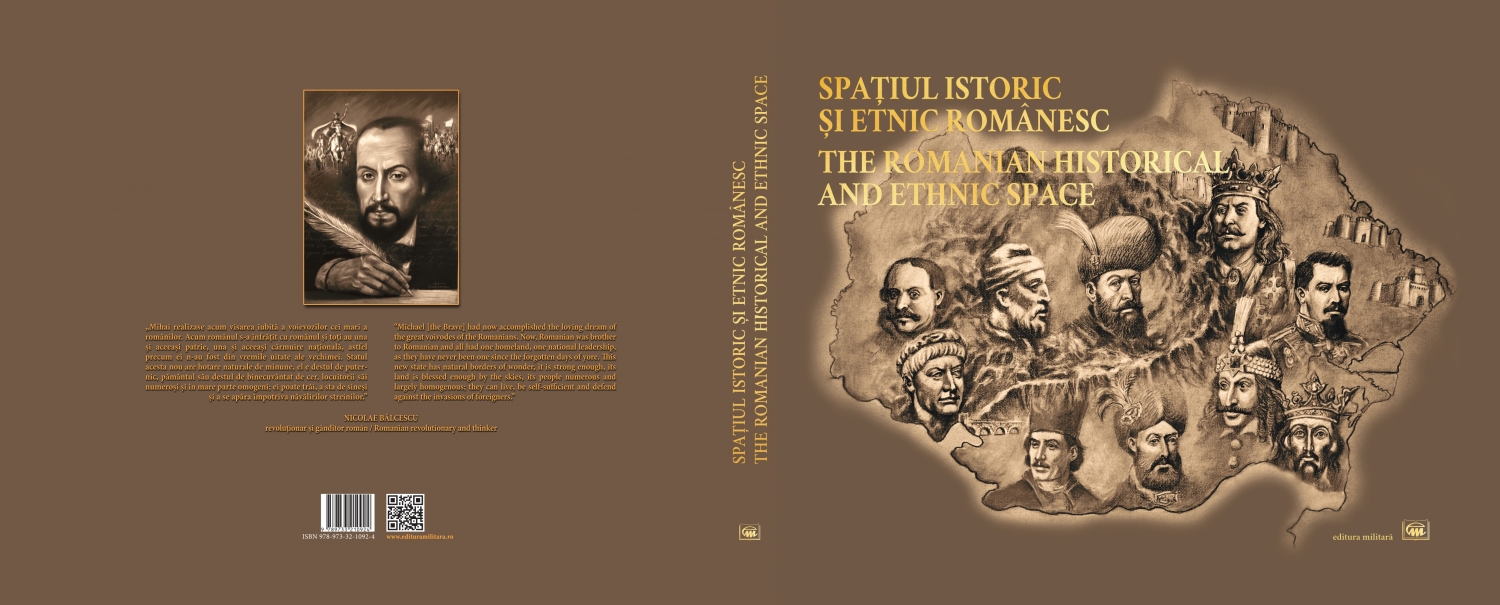
Cultural-historical project "ROMANIAN HISTORICAL AND ETHNIC SPACE"
The work "Romanian Historical and Ethnic Space", the piece de resistance of Romanian historiography, was launched under the prestigious aegis of the Military Publishing House in Bucharest, at the initiative and with the financial support of Computerland Romania.
Elaborated in its initial version during the difficult years of World War II, this extensive historical synthesis is an example of scientific probity and patriotism that unequivocally demonstrates the continuity of Romanism in the historical area of Burebista's and Decebal's Dacia. The remarkable work of a collective of historians of the time, the work constitutes an objective academic response to the anti-Romanian theses that have appeared over time.
The re-edition of this perfect work, without any commercial purpose, is the fruit of the generous work of a collective formed by great history lovers. These passionate people wanted to bring back to light a reference work for every Romanian and for Romania, starting from the thesis that "History is first and foremost called to find and speak the truth".
Compared to the initial work, new chapters were added, including both data from the Republic of Moldova and developments in historical realities that took place in Europe after 1945.
In order to constitute a documentary material of interest also for foreign readers, this work was edited in a bilingual Romanian - English format, being printed in Italy, at "Arc Group Italia SRL".
As can be seen from the first pages, this work of great erudition enjoys the support of the Romanian Academy, noting the exceptional presentations at the opening of the work, namely: “The Romanian Historical and Ethnic Space – The Foundation of Unified Romania since 1918” by Mr. Acad. Ioan-Aurel Pop and the “Foreword” offered by Mr. Acad. Razvan Theodorescu.
This historiographical approach was supported with particular dedication by Mr. Nicolae Badea, who brings to the readers' attention in the short presentation "Unspoken Words" the idea that "any projection of the future of a nation starts from a documented knowledge of its past."
We should not lose sight of the illustrations of covers I and IV, which are the work of the Romanian painter, Mr. Valentin Tanase.
This cultural-historical initiative initiated by Computerland Romania is addressed to both cultural and academic institutions, as well as public and private institutions that operate in Romania and abroad.
In this regard, several hundred copies were offered to personalities from the Romanian Senate, the Chamber of Deputies, ministries, embassies, city halls, the Patriarchate, colleges, schools and specialized academies, writers and journalists, personalities from the banking field and the Romanian and international private sector.
The Romanian historical and ethnic space – the basis of Unified Romania since 1918
Selections from the exceptional presentation of Mr. Acad. Ioan-Aurel Pop
"The Act of the Great Union was born from the internal need of the Romanian people to live in their own "home", destined to organize, protect and defend them, but it also came from the need for a new political architecture of the continent, within which a concert of nations was expected to function, after the destructive world conflict..
... Therefore, after 1848, the fundamental objective of the Romanians, who had been forming a modern nation since the 17th and 18th centuries, proved to be national political unity.
The leaders of the Romans (but not only them) understood then that every nation deserves to have its own unitary state, seen as a framework for the preservation and development of the national body, as a whole, and of each individual who composed this body..
... After 1848, the massive desire for the unification of Romanians in a national state was combined with international actions to obtain the support of the great powers..
… The unification of the Romanians into a national state included the following stages:
1) 1848-1859-1866: the union of Moldova and Wallachia into a state, officially called Romania and reformed according to the principles of Western democracy;
2) 1877-1878-1881: The proclamation of Romania's absolute independence, the war for independence and the fight for the official recognition of the country's independence internationally; the unification of Dobrogea with Romania and the elevation of the country to the rank of kingdom;
3) 1914-1918-1920: the participation of Romanians and Romania in the First World War; the unification of Bessarabia, Bukovina and Transylvania with Romania; the international recognition of the Romanian unitary national state within its historical borders…
… The formation of modern Romania and today's perception of this process have their own particularities, due both to the specifics of the more distant history of the Romanians and to the sui generis communist regime in Romania.
In the 40 years of communism proper, the national idea among Romanians has traveled a strange path from absolute denial and its condemnation "with proletarian rage" to its complete elevation among the Slavs, as the "red guiding thread of all history"..
… Romanians entered the era of freedom with a great handicap compared to their neighbors in other countries, even among the former socialist ones…
… After 1989, an unprecedented liberation followed, which brought great suffering to Romanians, and in the realm of history, it determined the fall, many times, to the other extreme…
… Today, in the context of the one hundred years that have passed since the end of the First World War, almost all peoples recall the events of that time, which led, in the years 1917-1920, to major territorial and ethnic changes, resulting, in large part, from the national emancipation movement and the collapse of multinational empires (at least in relation to the forms in which they had previously existed)…
… All the peoples of this part of Europe had to face serious challenges, living, for example, under the Ottomans, like the Bulgarians (from 1390 to 1878/1908) or like the Hungarians (1541-1699), being under Ottoman suzerainty like the Romanians (15th century-1878), being wiped off the map, like the Poles (18th century-1918) or no longer having their own state from the 10th century to 1918, like the Slovaks.
However, the Romanian Countries were never effectively integrated into the Ottoman Empire, they did not allow the Turks to be landowners north of the Danube, they did not allow Islamic propaganda to take place..
... Secondly, Romania was not formed a century ago, but was formed, through several medieval state nuclei, a millennium ago and was called the Romanian Country/Romanian Countries..
… Thirdly, the political architecture of Europe formed at the end of the First World War was broadly confirmed after the Second World War and after 1989 and is valid to this day…
... Just as there are no superior or inferior peoples in this world, Romanians should not have inferiority or superiority complexes either..
… There is no reason for victimization, but neither for euphoria. A century ago, Romania existed long ago…
… Therefore, when celebrating National Day on December 1, 2018, triumphalism must be weighed, because the Great Union was not made by today's generation, but by those great statesmen from 1918, imbued with the importance of their role in history…
... The acts of Romanian national will from 1918 have a perpetual durability, they have a strength that will make them last as long as the Romanian people endure.
The memory of the Great Union signifies the interest of Romanians in their "home" which is Romania, the desire to research its foundations, to know its architects and builders and to prepare it so that it reaches the hands of their children, grandchildren and great-grandchildren in good condition..
… This country was built by our ancestors, and the duty of our contemporaries is to preserve, perpetuate, protect and always renew it…
… Romania is no longer the same as it was in 1918-1920, but it is a country the size of the United Kingdom and is the sixth country among the 27 EU countries in terms of population (after Germany, France, Italy, Spain and Poland)…
... This book, in a bilingual edition, will help those who wish not only to better understand Romania, but also to place it much more realistically in the European concert, to know its aspirations and to see that Romanians are a people like any other, eager for dialogue, harmony and dignity.
"THE ROMANIAN HISTORICAL AND ETHNIC SPACE" Foreword
Text taken in full from the presentation made by Mr. Acad. Razvan Theodorescu
"In one of his famous radio conferences entitled "Counsels in the Dark", Nicolae Iorga said: "For every country and every nation there are certain great problems on which their right and future depend. Thus the length of the nation's residence in the homeland, the demonstration of higher qualities and the role it plays in all of humanity.".
These words were spoken on June 23, 1936, four years before his tragic death and the tragic amputations of a Romania for the defense and enhancement of which the national historian labored his entire miserable life.
The war that had already begun and that would dramatically involve our country also brought the issue of our historical rights over certain areas of Romanianness - I like the term and have been using it frequently lately - to the forefront of public opinion at home and abroad - if only in the perspective of a future peace, some barely lost through transactions between the great powers, others regained by force of arms and then lost again.
It was the moment when, under government patronage - we should not be shy to remember that it was the Antonescu regime (1942) -, historical specialists, geographers, sociologists, anthropologists were gathered to create a geopolitical synthesis that you can read in the following pages (republished with addenda that present the situation of Romania until today).
A synthesis in which dozens of maps and precise statistics accompanied by stoning historical notations indicated what Iorga had called "the antiquity of the nation's habitation" from the pre-Roman Dacia era until the interwar period, in a long dispute with a neighboring historiography and with the defenders of the theses who wanted to invalidate the decisions of 1919–1920 of the Paris Peace Conference and the Trianon agreements.
With an impeccably executed cartography that took into account not only Transylvania - the heart of the Romanian nation - but also the space from the north, towards Ceremus, the eastern space beyond the Prut and the southern one, beyond the Danube, the Romanian unity, so many times trampled underfoot - in 1775 with Bucovina, in 1812 with Bessarabia, in 1878 with the three southern Bessarabian counties, in 1940, with Northern Transylvania, with Bessarabia again, with the Dobrogean Quadrilateral -, is abundantly demonstrated by this collective work that shows with great precision that Romania, the "crossroads country" as it is rightly defined, is also a country with an ethnic and cultural specificity that must be emphasized.
It is, in a world that was considered "inter-imperial" - where three emperors extended their domination - the only southeastern European space where statehood was a multi-secular reality, through the autonomy of lords, voivodes, and the Church preserved as such from the period of the Turkocracy, when the Balkans and Hungary became fiefdoms fully subject to the Porte.
It is the only space of an Orthodox Latinity and of a Latin Orthodoxy, often uniting the pragmatism of the West with the ideocratic reflection of the East. It is the only space where a sedentary and ancient Christian people knew the presence of pagan Germanic, Finno-Ugric and Slavic migrants who, in contact with the Romanity of the Carpathians and the Lower Danube, converted here under the sign of the church of Constantinople, the "second Rome" (this is, among others, the case of Gyula's Hungarians, in Alba Iulia, more than a millennium ago, as proven by written sources and archaeological traces).
A Romanesque and then Romanian world, at first predominantly rural, on a "terra" from which the "peasants" emerged, continuing the traditions of ancient Rome and those of the pre-medieval "Romanians", establishing independent states in the Middle Ages, swarming over a very wide area, from Timoc to Transnistria, the ethnic community of the "Latins of the East" remains a strong, durable and deeply European island.
In the year of the Centennial of a hard-won unity, the exposition full of comparative meanings such as the present one, due - over seven decades ago - to patriotic and highly professional scholars, will be profitably consulted by academics and students, diplomats and politicians, for their and our common benefit."
WORDS UNSPOKE YET
Text taken in full from the introduction by Mr. NICOLAE BADEA
"Dear reader,
The idea of reprinting the work The Romanian Historical and Ethnic Space was born one day in 2017 when, by chance, I read on a page of an inconspicuous calendar these words of the great historian Nicolae Iorga: "A people that does not know its history is like a child that does not know its parents."
I realized then that any projection of a nation's future starts from a well-documented analysis of its past.
I searched the Library of the Romanian Academy and found an album first published in 1942 and reprinted 50 years later: The Romanian Historical and Ethnic Space.
Flipping through its pages yellowed by time, I had the image of a precious flower of the hand that had been waiting for a long time to be brought to light, to expose the unique beauty of its facets in the brilliance of time..
This is how I see this work: a sparkling compilation of the maps of Romania's historical development in the blessed space where Burebista and Decebal reigned, where the capital of Trajan's Dacia was, where the principalities and voivodeships that formed the Romanian Countries existed, where the Bessarabians, Musatins and Corvinists fought, where the Hora Unirii was sung and where the Romanian National Unitary State was created.
I wanted, through a completely private project, to join the efforts, which are not easy or simple, in the context of the present time, to celebrate the Centennial of the Great Unification of Romanians.
One hundred years of state consolidation… Two thousand years of historical development…
These are eras that have known exuberance, turmoil and distress, the search and discovery of the path to United Romania, historical times reflected in maps and documentary works that mirror the eternal struggle of Romanians to preserve national identity and to strongly affirm national sentiment.
By going through this work with your mind and heart, you will see, dear reader, that the history of the Romanians has several constants that no one can ever doubt and that time will not erase in its course: origin and language, territory, faith, culture and, above all, sacrifice.
This work of great erudition is a fresco of national destiny and is the fruit of meticulous and persevering work through which its authors responded to the anti-Romanian theses of the time when the Romanian Historical and Ethnic Space first saw the light of day.
Without this work, many of the arguments of Romanian historiography would not be and would not have been as comprehensive.
We opted for a bilingual edition because, for the first time, the historical atlas The Romanian Historical and Ethnic Space will go out into the world to serve as a research and information tool, a true guide that aims to make known the history of the Romanian nation, a nation that has always had its place on both sides of the Carpathians, on both sides of the lower Danube, the Tisa, and the Prut, next to the Great Sea.
Thank you to a wonderful team, without whose support this endeavor would not have been possible, just as I thank each individual member for their constant help and dedication to the project.
I also thank you, reader, for the moment of respite you will take to read this unique work, the true archaeology of the knowledge of the Romanian people.
I wish Romanians, wherever they may be, and Eternal Romania a vibrant, dignified and glorious future, like the history written by our ancestors!"